Where vacation homes dominate: Top US counties with the highest share of seasonal housing
For many Americans, owning a second home in a beloved vacation spot is more than a dream — it's a sign they've made it. From ski retreats in Colorado to summer cottages on Cape Cod, these seasonal homes are reshaping the housing landscape in dozens of counties across the country. And with mortgage rates projected to decline in 2025, the window may soon open for more people to buy a slice of their favorite escape.
A 2023 U.S. Census Bureau analysis of 2020 housing data shows that more than 4.3 million homes were classified as “vacant seasonal,” making this the largest category of vacant housing nationally. Using this data, along with housing price data from the National Association of Realtors, Wealth Enhancement mapped where vacation homes make up the highest share of housing and examined the economic ripple effects in these markets.
America's vacation home market by the numbers
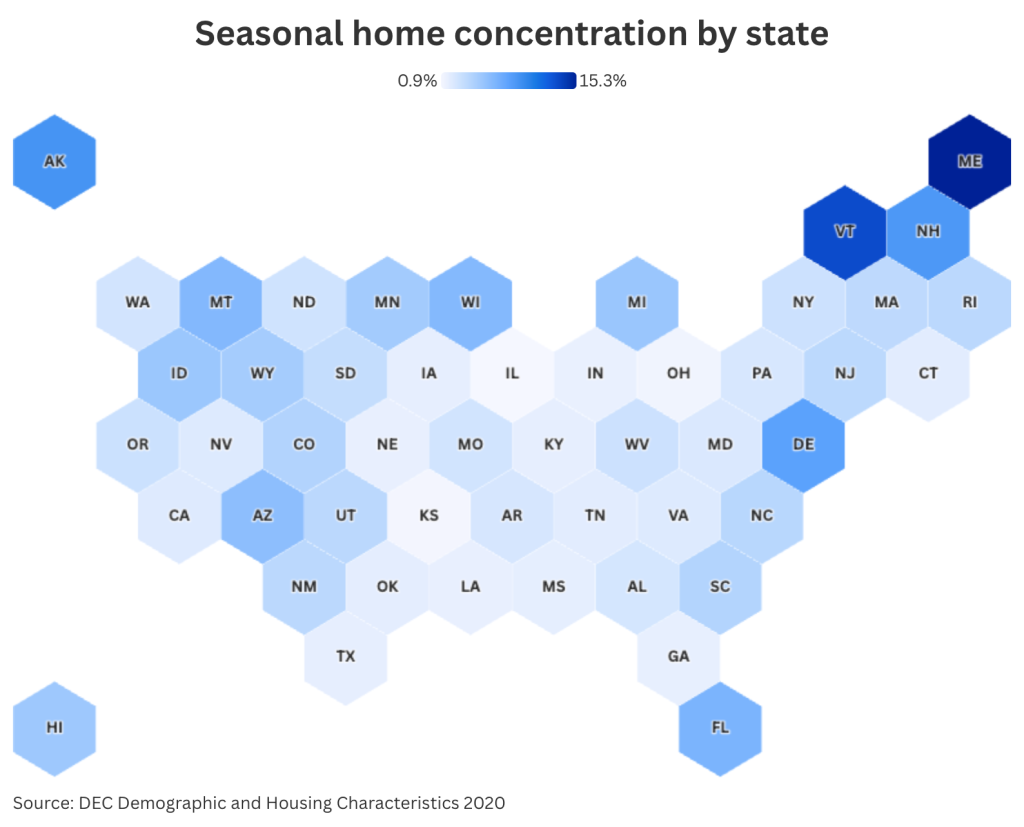
Seasonal homes are not a fringe market — far from it. According to the Census, seasonal housing units are the largest component of the nation's vacant housing inventory. They are heavily concentrated in coastal and mountain regions, where natural beauty, recreational opportunities, and rental demand intersect.
Florida stands out with 1 million second homes, making up over 15% of the national total.
Top vacation home counties: Where demand concentrates
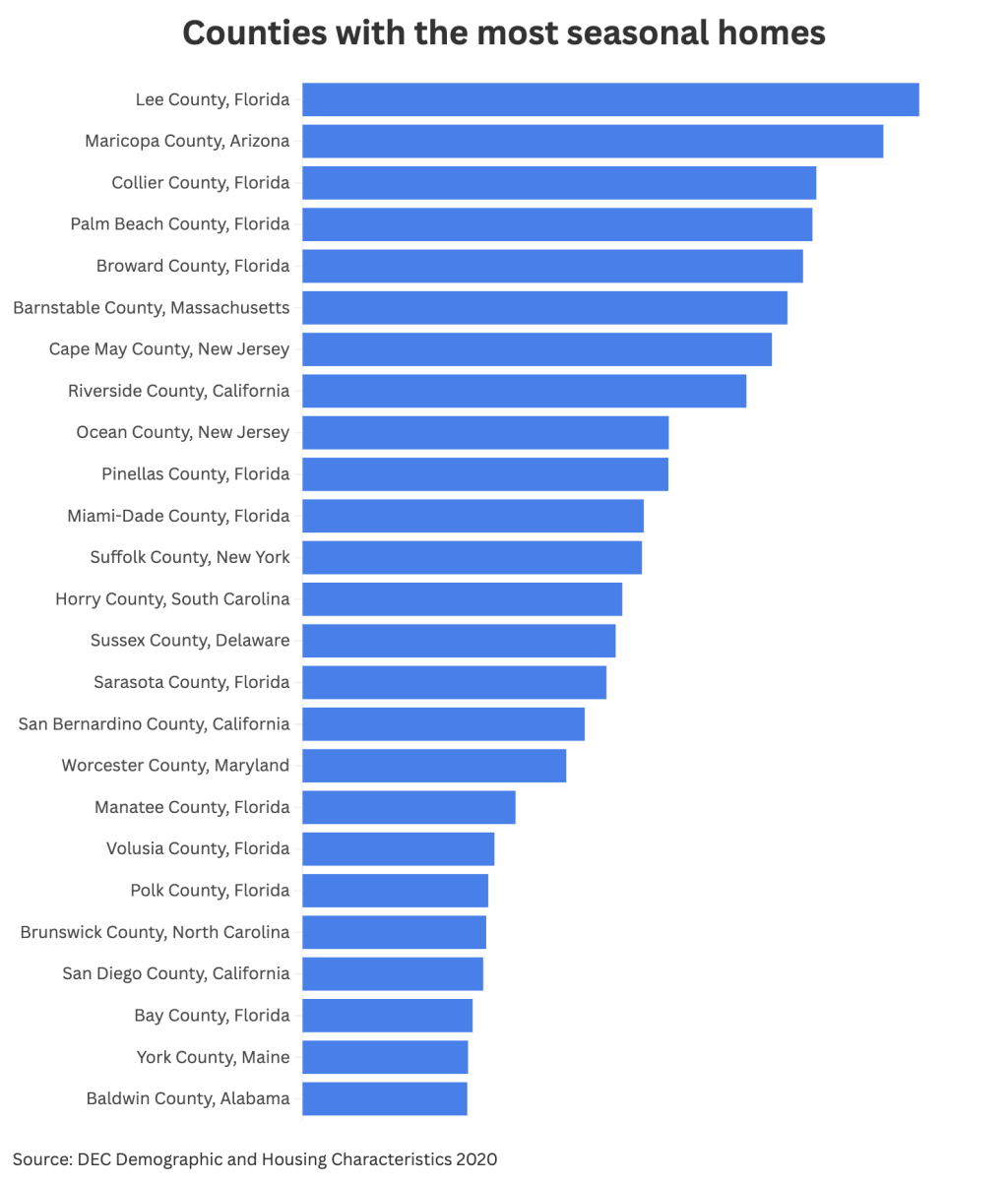
Focusing on counties with at least 5,000 total housing units, the data reveals which destinations are true second-home hotspots. These places attract seasonal residents for their scenic beauty, strong rental markets, and well-developed vacation economies.
Lee County, Florida: 69,007 seasonal homes, making up 17% of total housing; median price at $247,000
Barnstable County, Massachusetts: 54,267 seasonal homes, making up 33% of total housing; median price at $475,000
Collier County, Florida: 57,494 seasonal homes, making up 25% of total housing; median price at $314,000
Dukes County, Massachusetts: 7,747 seasonal homes, making up 44% of total housing; median price at $1,400,000
Colorado's ski counties and Michigan's lakefront areas also rank high, as do parts of the Pacific Northwest. In these areas, second homes can comprise a significant portion of the housing market, especially in small counties where seasonal population shifts are more noticeable.
Economic impact: How seasonal demand shapes local markets
Seasonal housing brings unique dynamics to local real estate markets. Unlike primary residences, vacation homes are subject to more pronounced seasonal price fluctuations and can limit inventory for full-time residents. According to Investopedia, seasonal trends can drive 5% to 10% swings in home prices depending on the time of year.
Local economies, meanwhile, often rely on these properties for tourism revenue and jobs. On Cape Cod, for instance, second homes make up 37% of the housing stock. Boston 25 News reported that since 2021, the number of rental property owners there has jumped 48%. Aspen, Colorado, sees economic activity year-round thanks to its status as a resort and arts and culture destination with demand for home maintenance, rental management, and hospitality services.
Interest rate impact and 2025 market outlook
Interest rates may make vacation homeownership more accessible again. Morgan Stanley projects that the 30-year mortgage rate, which sits at 6.77% as of June 26, could fall to as low as 6.25% by late 2025. A 0.75% drop would cut payments on a $1 million mortgage by about $400 per month, significant for buyers weighing the cost of a second property.
Rate changes uniquely affect vacation home sales, since these purchases are often discretionary and require larger down payments. If rates decline, many high-income buyers may see 2025 as the ideal time to lock in their dream destination home.
What draws buyers to prime vacation destinations
The appeal of vacation home markets goes beyond aesthetics. These places tend to offer:
Scenic amenities like beaches, mountains, or lakes
High rental income potential during peak seasons
Proximity to urban areas for weekend getaways
Strong resale value and long-term price appreciation
Established infrastructure to support tourism and seasonal living
Whether it's for investment, lifestyle, or legacy, owning a second home remains a powerful aspiration and a market force to watch.
Conclusion
Seasonal homes are transforming real estate markets across the U.S. With over 6 million second homes already in circulation and interest rates poised to dip in 2025, the appetite for vacation properties may soon grow even stronger. For would-be buyers, knowing where these homes concentrate — and how they impact local economies — can help identify the best opportunities for long-term value and lifestyle enjoyment.
If you're considering a vacation home in Connecticut, understanding the local market is key to making a smart investment. As a Realtor specializing in Connecticut real estate, I can help you navigate these trends and find the perfect property that meets your lifestyle goals and financial objectives. Contact me today to learn more about the opportunities available in our beautiful state.
Facebook X Linkedin Market Analysis The Hartford County Real Estate “Freshness Report” Why Now is the Strategic Time to Sell If you’ve been watching the real estate market, you might be looking at average prices and “days on market” and wondering where your home fits in. But the “averages” are hiding two very different opportunities […]
Facebook X Linkedin Navigating the Hartford County Condo Market: Modern Living Meets Investment Value The condominium market in Hartford County is currently a hotspot for both first-time homebuyers and savvy investors. Offering a low-maintenance lifestyle and a wide range of price points, condos are proving to be a resilient segment of our local real estate […]
Exploring the Connecticut Multi-Family Market: Building Wealth Through Real Estate The real estate market in Connecticut continues to offer exciting opportunities for investors, particularly in the multi-family sector. Whether you are a first-time investor looking for your first duplex or a seasoned professional scaling up to larger commercial buildings, understanding the current landscape is the […]
Blame it on the Snow: Why February’s Real Estate Stats Tell a “Chilly” Story If you feel like you spent more time with a shovel than a “For Sale” sign this past month, you aren’t alone. This winter has been one for the record books, and the latest February report from the Greater Hartford Association […]
Facebook X Linkedin Selling a Condo in Connecticut? Check Your Master Policy First If you own a condo or a home in a managed community in Connecticut, the “hidden” deal-killer in today’s market isn’t a bad inspection or a low appraisal-it’s your HOA’s insurance policy. A quiet but massive shift in the insurance industry is […]
Facebook X Linkedin Beyond the Primary Residence: Where the Ultra-Wealthy Are Investing When it comes to luxury real estate, the most discerning buyers are not just focused on their primary residence. They’re making strategic investments in properties that offer a lifestyle and a legacy. For these individuals, a second home isn’t just a vacation spot; […]
CT Real Estate Investors: Will Our Market Follow the National “Buyer’s Market” Trend? Facebook X Linkedin You’ve probably seen the national headlines predicting a widespread shift to a buyer’s market. But here in Connecticut, the story is often more nuanced. While some regions across the country are seeing significant inventory increases and price corrections, our […]
You've probably seen the national headlines predicting a widespread shift to a buyer's market. But here in Connecticut, the story is often more nuanced. While some regions across the country are seeing significant inventory increases and price corrections, our market continues to dance to its own rhythm, largely remaining a strong seller's market in many areas.
As a realtor working daily in the Connecticut real estate marketplace, I can tell you that the fundamental dynamics here – particularly the persistently low inventory – are what keep prices elevated and demand robust, even with higher interest rates.
Don't confuse national activity with Connecticut progress. Consistency in your investment strategy is key, but it must be aligned with what's working in our specific local environment. If your current approach isn't consistently:
Unearthing off-market or undervalued properties
Securing deals with favorable terms
Generating the returns you expect for CT's unique conditions
...then it's time to pivot.
Why Connecticut often defies national trends (and why it matters for investors):
Stubbornly Low Inventory: Unlike other parts of the country that built extensively, Connecticut has seen very limited new construction for years. The "lock-in effect" of homeowners with low rates further restricts supply. This scarcity is our primary market driver.
Continued Influx: While the pandemic-era surge from NYC has somewhat cooled, we still see steady interest from those seeking more space, better value, and a higher quality of life than neighboring states.
Strong Local Demand: Even with higher rates, there's a consistent pool of local buyers and renters in many desirable CT towns and cities, driven by employment, lifestyle, and a desire for homeownership.
Delayed Response: Historically, Connecticut tends to be a year or two behind national real estate cycles. When other markets soar, we follow, and when they dip, we often hold steady for longer.
So, will Connecticut follow the national "buyer's market" suit? While isolated pockets may see more balance, a broad, sustained shift to a buyer's market across most of CT isn't imminent without a dramatic increase in inventory or a significant economic downturn.
For smart investors, this means adapting your strategy to CT's realities. Focus on:
Hyper-local market analysis, not just national news.
Building strong local networks for off-market opportunities.
Understanding the specific demand drivers in your target towns.
Are You Still Investing With a 2021 Mindset in Connecticut?
Let's discuss how to navigate Connecticut's unique market to ensure your investment activity truly leads to progress.
Navigating the Shift: Portfolio Positioning Guide Macro Strategy & Real Estate Navigating the Shift: How to Position Your Portfolio as Bonds Sell Off and Housing Hits Its Seasonal Peak Market Insights • Portfolio Strategy Guide As we cruise through mid-May, we are officially entering the absolute peak of the spring housing market. Sidewalks are busy, […]
The Wealth Preservation Pivot Capitalizing on West Hartford’s Appreciation to Secure a Low-Carry Lifestyle If you own property in West Hartford, you are likely sitting on significant equity. Demand for luxury real estate across Connecticut-and specifically in our high-density hubs-is on a steady rise. For many homeowners, this creates a psychological “waiting game”: Is this […]
Market Insights What is the right listing price to command the highest premium? A data-driven analysis of West Hartford sales (Last 60 Days). Avg. Over Asking $45,349 Median DOM 5 Days Highest Premium 36.7% In today’s West Hartford market, your list price is more than a number-it’s a strategic lever. Based on 61 recent closed […]
Seller Strategy Know Your Competition: Why Savvy Sellers Should Scout Local Open Houses Selling a home is a competitive business. While it might feel counterintuitive to visit other listings when you’re busy prepping your own, attending local open houses is one of the most effective ways to gain a strategic advantage. It’s not about finding […]
Linkedin Facebook X Market Analysis: Decoding Buyer Demand in Hartford County By Alex Teplitskiy | Real Estate Insights In real estate, we often talk about the “sweet spot” of the market. To a casual observer, that might look like the price range where the most homes are selling. But for a savvy buyer or seller, […]
Facebook X Linkedin The Great Divide: Why Hartford is Defying National Real Estate Trends If you’ve been watching the national news lately, you might think the housing market is finally cooling off. Headlines from the National Association of Realtors (NAR) show inventory is rising and sales are slowing. But if you are looking for a […]
The corporate world's relentless pursuit of "lean" operations, largely powered by aggressive AI adoption, is not merely an internal efficiency drive. For property owners and real estate investors, it represents a profound, interconnected transformation that extends far beyond a typical market cycle. This is a structural shift, bringing both significant threats and compelling new opportunities.
The Commercial Office Space Conundrum: A Retreat from Physical Footprints
Companies are increasingly leveraging AI to automate tasks, streamline workflows, and enable more flexible, often remote, workforces. While this promises boosted profitability and reduced overhead, its direct consequence is a dramatically shrinking need for physical office space.
Permanent Vacancy Spikes: We are already observing rising vacancy rates in major urban centers. This trend is set to accelerate, leading to sustained and dramatically higher vacancies in commercial office buildings. This is not a temporary dip; it signals a fundamental, long-term reduction in demand, directly resulting in the significant devaluation of office properties. Reports indicate office vacancy rates could climb to 23% by 2025 and 24% by 2026.
Imminent Banking Sector Strain: Financial institutions with substantial exposure to commercial real estate loans face an unprecedented wave of defaults and immense financial pressure. As property values decline and income streams from rentals dwindle, the stability of these loan portfolios becomes precarious. This financial stress will undoubtedly lead to severely tightened loan criteria across all lending sectors, restricting access to capital for businesses and individuals alike, and potentially impacting broader economic liquidity.
Urban Development Paralysis: The widely discussed strategy of converting vacant office buildings into residential units, while appealing in theory, will prove insufficient, economically prohibitive, and agonizingly slow to absorb the sheer volume of excess commercial space. Many urban cores could face stagnation, marked by underutilized assets and a slowing pace of revitalization.
The Residential Ripple: Shifting Demographics and Strained Affordability
The impact doesn't stop at the office door. The effects on employment and earning capacity directly translate into profound changes for the residential rental market:
Fundamental Shift in Rental Demand Patterns: If AI-driven automation leads to fewer people commuting daily to central business districts or fewer jobs available within them, the historical premium on apartments in dense urban cores may diminish. This could result in softening demand and potentially lower rents in previously highly sought-after downtown areas. Conversely, while suburbs might see initial influxes, widespread unemployment will ultimately strain affordability everywhere.
Erosion of Tenant Affordability and Increased Strain: A surge in AI-driven unemployment or widespread wage stagnation will directly impact the financial capacity of a significant portion of the population. This translates to reduced ability to afford current rents, potentially leading to higher rates of delinquency, defaults, and a surging demand for affordable housing solutions that the market is ill-equipped to provide. Economic hardship will force more individuals and families into precarious housing situations or multi-generational living, further reducing individual household formation.
Mismatched Housing Supply from Conversions: Even where office-to-residential conversions occur, they often yield luxury or high-end units, creating a mismatch between the new supply and the actual demand for affordable housing, particularly for those impacted by job displacement. This could exacerbate market imbalances, leading to an oversupply in one segment while the affordable segment remains critically underserved.
The Path Forward: Navigating Risk and Seizing New Opportunities
This isn't a speculative future; it's an unfolding reality that demands immediate, explicit confrontation and proactive strategic planning. For office and rental property owners, understanding these converging forces is not just prudent—it's essential for survival and growth. While traditional real estate models are being fundamentally challenged, new segments are emerging as attractive opportunities:
Data Centers: The insatiable demand for AI's computational power directly fuels explosive growth in this segment. Investing in specialized, high-tech infrastructure for data processing and storage offers a direct play on the AI revolution itself.
Industrial & "Last-Mile" Logistics: E-commerce continues its expansion, and AI-optimized supply chains necessitate highly efficient warehousing and distribution closer to consumers. Properties designed for rapid fulfillment and automation remain a robust investment.
Life Sciences & Specialized R&D Facilities: AI is revolutionizing biotech and medical research, yet the hands-on nature of lab work means these highly specialized facilities remain indispensable. Demand for purpose-built labs and research parks in key biotech clusters is strong.
Student Housing & Education-Adjacent Properties: As the workforce adapts to AI, continuous upskilling and reskilling are paramount. Properties near universities, community colleges, and vocational training centers cater to a stable tenant base driven by the ongoing need for education and career evolution.
Strategic Affordable & Workforce Housing: Despite potential unemployment, fundamental housing demand persists. Focus on well-managed properties in economically resilient areas with diverse employment bases, especially those serving essential workers or sectors less vulnerable to immediate AI displacement.
The future of real estate is not simply about what disappears, but about strategically identifying and investing in what emerges stronger. This requires deep insight, proactive adaptation, and innovative solutions to both mitigate the inevitable challenges and capitalize on the nascent opportunities.
Ready to Re-Strategize Your Real Estate Portfolio?
As a dedicated real estate professional deeply engaged with these macro trends, I specialize in helping property owners like you navigate this complex, evolving landscape. My services are designed to help you:
Analyze market shifts to identify properties at risk or poised for growth.
Strategically buy, sell, or lease commercial and residential properties in a transformed market.
Identify and acquire lucrative opportunities within resilient and emerging real estate segments.
Connect with qualified buyers or tenants who understand the new market dynamics.
Develop effective listing and marketing strategies for properties adapting to new demands.
Let's discuss how your real estate investments can not only withstand but potentially thrive amidst this unprecedented era of change.
Contact me today for a no-obligation market analysis or consultation!
Navigating the Shift: Portfolio Positioning Guide Macro Strategy & Real Estate Navigating the Shift: How to Position Your Portfolio as Bonds Sell Off and Housing Hits Its Seasonal Peak Market Insights • Portfolio Strategy Guide As we cruise through mid-May, we are officially entering the absolute peak of the spring housing market. Sidewalks are busy, […]
The Wealth Preservation Pivot Capitalizing on West Hartford’s Appreciation to Secure a Low-Carry Lifestyle If you own property in West Hartford, you are likely sitting on significant equity. Demand for luxury real estate across Connecticut-and specifically in our high-density hubs-is on a steady rise. For many homeowners, this creates a psychological “waiting game”: Is this […]
Market Insights What is the right listing price to command the highest premium? A data-driven analysis of West Hartford sales (Last 60 Days). Avg. Over Asking $45,349 Median DOM 5 Days Highest Premium 36.7% In today’s West Hartford market, your list price is more than a number-it’s a strategic lever. Based on 61 recent closed […]
Seller Strategy Know Your Competition: Why Savvy Sellers Should Scout Local Open Houses Selling a home is a competitive business. While it might feel counterintuitive to visit other listings when you’re busy prepping your own, attending local open houses is one of the most effective ways to gain a strategic advantage. It’s not about finding […]
Linkedin Facebook X Market Analysis: Decoding Buyer Demand in Hartford County By Alex Teplitskiy | Real Estate Insights In real estate, we often talk about the “sweet spot” of the market. To a casual observer, that might look like the price range where the most homes are selling. But for a savvy buyer or seller, […]
Facebook X Linkedin The Great Divide: Why Hartford is Defying National Real Estate Trends If you’ve been watching the national news lately, you might think the housing market is finally cooling off. Headlines from the National Association of Realtors (NAR) show inventory is rising and sales are slowing. But if you are looking for a […]
Facebook X Linkedin Why “Zestimating” Your CT Home Could Cost You Thousands If you’re looking at homes in Connecticut, you’ve likely seen the Zestimate. It’s convenient and instant, but according to recent data, it is surprisingly off the mark for our unique local market. While Zillow’s algorithm performs well in states with high-density subdivisions like […]
Buying a home is a major life milestone, and for many, the potential tax benefits associated with homeownership, like the mortgage interest deduction, are a welcome perk. However, if you're buying a home today, it's essential to understand that the ability to deduct mortgage interest has limitations, and it's not a blanket deduction for all homeowners.
The Good News: You Can Still Deduct Mortgage Interest
The mortgage interest deduction is still a valuable tax benefit for many homeowners. It allows you to reduce your taxable income by a certain amount of the interest you've paid on your home loan throughout the year.
Here's where the limitations come in:
Mortgage Debt Limits: The Tax Cuts and Jobs Act (TCJA) of 2017 reduced the amount of mortgage debt on which you can deduct interest for loans taken out after December 15, 2017.
a) For homes purchased after December 15, 2017, you can deduct interest on up to $750,000 of combined mortgage debt (including your primary residence and a second home). If you are married and filing separately, this limit is $375,000.
b) If you purchased your home on or before December 15, 2017, you can deduct interest on up to $1 million of combined mortgage debt ($500,000 if married filing separately).
Home Equity Loan and HELOC Interest: The rules for deducting interest on home equity loans and lines of credit (HELOCs) also changed. For interest to be deductible, the loan funds must be used to buy, build, or substantially improve your primary or second home. You can no longer deduct interest on home equity loans used for personal expenses like paying off credit cards or taking a vacation.
Itemizing Deductions: To claim the mortgage interest deduction, you must itemize your deductions on Schedule A (Form 1040) instead of taking the standard deduction. Since the TCJA significantly increased the standard deduction, many taxpayers now find that their total itemized deductions, including mortgage interest, do not exceed the standard deduction amount, making itemizing less beneficial.
What this means for you if you're buying today:
Understand the Limits: Be aware of the $750,000 mortgage debt limit for loans taken out after December 15, 2017.
Plan Your Home Equity Loan Usage: If you plan to take out a home equity loan or HELOC in the future, ensure the funds are used for eligible purposes (buying, building, or substantially improving your home) to potentially deduct the interest.
Compare Itemizing vs. Standard Deduction: Carefully consider whether itemizing your deductions will benefit you more than taking the standard deduction, given the potentially higher standard deduction amounts. You can use tax software or consult a tax professional to help you determine which approach is best for your situation.
Keep Good Records: Ensure you have the necessary documentation, like Form 1098 from your lender, to support your mortgage interest deduction claim.
Important Note: The current rules regarding mortgage interest deduction limits are set to expire at the end of 2025. Congress may or may not act to extend, modify, or let these provisions expire. This could impact the deduction limits in the future, so staying informed is crucial.
In conclusion, while the mortgage interest deduction remains a valuable benefit, it's not a "hole mortgage interest" deduction. By understanding the now-permanent limitations and planning accordingly, you can make informed decisions and potentially maximize your tax savings as a homeowner.
Ready to explore homeownership?
Understanding the tax implications, like the mortgage interest deduction, is just one piece of the puzzle when buying a home. As a realtor, expert guidance can be provided throughout the entire process, from finding the perfect property to guiding through the closing.
Important Disclaimer: This article provides general information about the mortgage interest deduction for educational purposes only and should not be considered financial or tax advice. Tax laws are complex and subject to change. Please consult with a qualified CPA or tax professional to determine how these rules apply to your specific situation.
Let's connect! If you're considering buying or selling a home, let's discuss your real estate goals. Expert guidance can be provided throughout the journey.
Navigating the Shift: Portfolio Positioning Guide Macro Strategy & Real Estate Navigating the Shift: How to Position Your Portfolio as Bonds Sell Off and Housing Hits Its Seasonal Peak Market Insights • Portfolio Strategy Guide As we cruise through mid-May, we are officially entering the absolute peak of the spring housing market. Sidewalks are busy, […]
The Wealth Preservation Pivot Capitalizing on West Hartford’s Appreciation to Secure a Low-Carry Lifestyle If you own property in West Hartford, you are likely sitting on significant equity. Demand for luxury real estate across Connecticut-and specifically in our high-density hubs-is on a steady rise. For many homeowners, this creates a psychological “waiting game”: Is this […]
Market Insights What is the right listing price to command the highest premium? A data-driven analysis of West Hartford sales (Last 60 Days). Avg. Over Asking $45,349 Median DOM 5 Days Highest Premium 36.7% In today’s West Hartford market, your list price is more than a number-it’s a strategic lever. Based on 61 recent closed […]
Seller Strategy Know Your Competition: Why Savvy Sellers Should Scout Local Open Houses Selling a home is a competitive business. While it might feel counterintuitive to visit other listings when you’re busy prepping your own, attending local open houses is one of the most effective ways to gain a strategic advantage. It’s not about finding […]
Linkedin Facebook X Market Analysis: Decoding Buyer Demand in Hartford County By Alex Teplitskiy | Real Estate Insights In real estate, we often talk about the “sweet spot” of the market. To a casual observer, that might look like the price range where the most homes are selling. But for a savvy buyer or seller, […]
Facebook X Linkedin The Great Divide: Why Hartford is Defying National Real Estate Trends If you’ve been watching the national news lately, you might think the housing market is finally cooling off. Headlines from the National Association of Realtors (NAR) show inventory is rising and sales are slowing. But if you are looking for a […]
Facebook X Linkedin Why “Zestimating” Your CT Home Could Cost You Thousands If you’re looking at homes in Connecticut, you’ve likely seen the Zestimate. It’s convenient and instant, but according to recent data, it is surprisingly off the mark for our unique local market. While Zillow’s algorithm performs well in states with high-density subdivisions like […]
Summer in Connecticut brings out the undeniable allure of the shoreline – the sun-kissed beaches, the vibrant coastal towns, and the promise of a relaxed lifestyle. While the warmer months offer an ideal time to enjoy all that the shoreline has to offer, they can also be a strategic time to assess potential locations and properties if you're considering purchasing your own piece of coastal paradise during the off-season.
Why Summer is the Perfect Scouting Season:
Experience the Peak: Summer is the busiest time for shoreline communities, allowing you to experience them at their liveliest. You'll get a true sense of the atmosphere, traffic, and the number of visitors drawn to the area.
Assess Amenities: Observe how amenities like restaurants, shops, and attractions operate during peak season. This will give you a realistic view of convenience and crowds.
Observe Waterfront Features: See firsthand how properties handle summer tides, crowds, and weather conditions. This can be crucial for assessing potential issues like erosion or proximity to high-traffic areas.
Visualize the Lifestyle: Spending time in the area allows you to immerse yourself in the lifestyle and determine if it aligns with your long-term goals.
Strategic Assessment During Your Summer Visits:
Explore Different Towns: Connecticut's coastline offers a variety of towns, each with its unique character. Visit different areas, like Mystic, Groton, Essex, or Old Saybrook, to find the one that best suits your preferences.
Focus on Location, Location, Location: Pay attention to a property's proximity to the beach, marinas, and other amenities. Also, consider commute times and access to transportation.
Consider the Off-Season: While experiencing summer, try to envision what the area would be like during the quieter months.
Talk to Locals: Engage with residents and business owners to gather insights into the community and its seasonal variations.
Preparing for Off-Season Purchase:
Seek Professional Guidance: Team up with a real estate agent specializing in shoreline properties to guide you through the process and access relevant information.
Understand Coastal Regulations: Familiarize yourself with the Connecticut Coastal Management Act and consult with local conservation commissions and the DEEP to understand any environmental regulations that could affect a property.
Consider Financing Options: Get pre-approved for a mortgage to streamline the purchase process and gain a better understanding of your budget.
Review Property Information: Carefully examine property listings and any information available about potential homes, including photos, descriptions, and disclosed issues.
Ready to turn these insights into your next successful move?
By taking a strategic approach to your summer shoreline visits, you can gain valuable insights and position yourself for a successful off-season purchase, securing your own piece of Connecticut's beautiful coastline.
Ready to find your slice of Connecticut's coastal paradise? The summer offers a unique opportunity to experience the shoreline lifestyle firsthand and lay the groundwork for a smart off-season purchase. As a local expert in Connecticut shoreline properties, assistance is available to navigate the market and find the perfect home that aligns with your vision and budget.
Don't just dream of a beach house – make it a reality!
Navigating the Shift: Portfolio Positioning Guide Macro Strategy & Real Estate Navigating the Shift: How to Position Your Portfolio as Bonds Sell Off and Housing Hits Its Seasonal Peak Market Insights • Portfolio Strategy Guide As we cruise through mid-May, we are officially entering the absolute peak of the spring housing market. Sidewalks are busy, […]
The Wealth Preservation Pivot Capitalizing on West Hartford’s Appreciation to Secure a Low-Carry Lifestyle If you own property in West Hartford, you are likely sitting on significant equity. Demand for luxury real estate across Connecticut-and specifically in our high-density hubs-is on a steady rise. For many homeowners, this creates a psychological “waiting game”: Is this […]
Market Insights What is the right listing price to command the highest premium? A data-driven analysis of West Hartford sales (Last 60 Days). Avg. Over Asking $45,349 Median DOM 5 Days Highest Premium 36.7% In today’s West Hartford market, your list price is more than a number-it’s a strategic lever. Based on 61 recent closed […]
Seller Strategy Know Your Competition: Why Savvy Sellers Should Scout Local Open Houses Selling a home is a competitive business. While it might feel counterintuitive to visit other listings when you’re busy prepping your own, attending local open houses is one of the most effective ways to gain a strategic advantage. It’s not about finding […]
Linkedin Facebook X Market Analysis: Decoding Buyer Demand in Hartford County By Alex Teplitskiy | Real Estate Insights In real estate, we often talk about the “sweet spot” of the market. To a casual observer, that might look like the price range where the most homes are selling. But for a savvy buyer or seller, […]
Facebook X Linkedin The Great Divide: Why Hartford is Defying National Real Estate Trends If you’ve been watching the national news lately, you might think the housing market is finally cooling off. Headlines from the National Association of Realtors (NAR) show inventory is rising and sales are slowing. But if you are looking for a […]
Facebook X Linkedin Why “Zestimating” Your CT Home Could Cost You Thousands If you’re looking at homes in Connecticut, you’ve likely seen the Zestimate. It’s convenient and instant, but according to recent data, it is surprisingly off the mark for our unique local market. While Zillow’s algorithm performs well in states with high-density subdivisions like […]
Connecticut's real estate landscape is a dynamic interplay of population shifts, economic vitality, and social indicators. As of the most recent data, the state presents a compelling picture for anyone involved in buying, selling, or investing in property.
Connecticut Data Snapshot (Most Recent Available):
Population: Approximately 3.675 million (2024)
Median Household Income:$93,760 (2023)
Percentage with at least a Bachelor's Degree:41.9% (2019-2023)
Hispanic or Latino Population: Approximately 641,000 or 17.8% of the total population (2023)
Uninsured Individuals:5.5% (2023)
These figures, while seemingly disparate, collectively paint a detailed picture of the state's economic health and demographic makeup, both of which are crucial for understanding and navigating its real estate market.
The Deep Dive: Why These Numbers Matter for Real Estate
1. Population: The Foundation of Demand
A stable or growing population is the bedrock of real estate demand. Connecticut's population of 3.675 million in 2024, showing modest stability, is a critical factor. Each individual represents a potential resident, contributing to household formation and the fundamental need for housing units, whether for sale or rent. While significant population surges drive rapid market expansion, Connecticut's consistent numbers suggest sustained, rather than volatile, demand. This stability supports a healthy base for long-term real estate investment, as properties are less likely to experience sharp downturns due to a shrinking buyer or renter pool.
2. Median Household Income: Fueling Affordability and Purchasing Power
With a median household income of $93,760 in 2023, Connecticut boasts a relatively affluent populace compared to the national average. This high income level is a direct driver of housing affordability. Higher incomes enable residents to:
Afford higher home prices: They can qualify for larger mortgages and absorb rising property values.
Support robust rental markets: A strong income base means renters can afford higher rents, benefiting property owners.
Despite rising home prices (the median sale price for single-family homes was $432,500 in March 2025), Connecticut's median income suggests that homeownership remains accessible for a substantial segment of the middle class, especially in regions outside the most expensive areas like Fairfield County. This purchasing power underpins continued buyer interest and market stability.
3. Educational Attainment: Driving Desirability and Value
The impressive 41.9% of Connecticut residents holding at least a Bachelor's degree (2019-2023) indicates a highly educated workforce. This statistic is profoundly impactful for real estate:
Higher Earning Potential: Education often correlates with higher-paying jobs, further enhancing residents' capacity to invest in housing.
Desirable Neighborhoods: Areas with high educational attainment typically feature strong school systems, a wider array of amenities, and a vibrant professional environment. These factors enhance a neighborhood's desirability, leading to increased property values and sustained demand. For real estate professionals, identifying these highly educated corridors can pinpoint areas of strong appreciation and rental growth.
Specific Housing Preferences: An educated populace may seek out particular housing characteristics, such as modern designs, proximity to cultural centers, or homes in top-tier school districts, influencing development and architectural trends.
4. Hispanic or Latino Population: A Growing Market Segment
The Hispanic or Latino population, standing at approximately 641,000 or 17.8% in 2023, represents a significant and growing demographic force in Connecticut's real estate market. This community often includes a substantial proportion of first-time homebuyers, creating consistent demand for entry-level and moderately priced homes. For real estate developers, understanding the specific needs and cultural preferences of this group can open up new opportunities for tailored housing projects and community-focused developments. Real estate agents who are culturally fluent and can serve this demographic effectively will find a strong and loyal client base.
5. Uninsured Individuals: An Indicator of Economic Stability
A relatively low uninsured rate of 5.5% in 2023 is a positive economic indicator for the real estate market. A population with broad health insurance coverage generally experiences greater financial stability. This means:
Reduced Financial Risk: Unexpected medical emergencies are less likely to lead to severe financial distress, such as mortgage defaults or evictions. This translates to more reliable tenants and homeowners.
Enhanced Consumer Confidence: When a population feels secure in their health and financial well-being, they are more likely to make long-term investments, including purchasing property. This confidence contributes to a robust and resilient housing market.
The Current Connecticut Real Estate Landscape (2025 Outlook)
This case serves as a powerful testament to why, despite technological advancements, real estate agents are far from obsolete. Here's why you might want to hold onto your trusted agent:
Market Nuance and Human Intuition: While AI can process vast amounts of data, it often struggles with the nuanced, intangible factors that influence home values and market trends. An experienced agent possesses local market knowledge, an understanding of neighborhood-specific dynamics, and an intuitive grasp of buyer and seller psychology – elements that an algorithm, however sophisticated, may miss.
Adapting to Volatility: The Opendoor situation highlights the critical need for adaptability in a dynamic market. Real estate agents, with their boots on the ground, can quickly pivot strategies in response to rising interest rates, shifting buyer demand, or economic downturns, offering personalized advice and negotiation skills that algorithms simply cannot replicate.
The Emotional Journey: Buying or selling a home is often one of the most significant financial and emotional decisions a person makes. Agents provide essential support, empathy, and guidance, navigating the complexities and stresses of the process with a human touch that AI cannot deliver. They act as trusted advisors, not just transaction facilitators.
Problem Solvers and Negotiators: Real estate transactions are rarely seamless. Unexpected issues, from inspections to financing, often arise. Agents are skilled problem-solvers and negotiators, advocating for their clients' best interests and finding solutions that can make or break a deal.
Network and Local Connections: Agents bring a valuable network of contacts – from lenders and inspectors to contractors and other agents – that can streamline the entire process. This established network is a vital resource for both buyers and sellers.
Connecticut's real estate market is currently characterized by a competitive environment, primarily driven by low inventory and strong demand.
Seller's Market: The number of active single-family home listings in March 2025 saw only a slight year-over-year increase, keeping selection tight. This results in homes selling quickly (average of 34 days on market for single-family homes) and often above asking price, especially in desirable areas.
Rising Prices: The median sale price for single-family homes rose by 6.8% to $432,500 in March 2025, with condo prices also appreciating. This steady appreciation indicates a healthy market with sustained buyer interest. Connecticut has recently ranked among the top states for home price increases nationally.
Condo Opportunities: The condo market shows more promising inventory growth (25.7% increase year-over-year in active listings), offering more choices and potentially less intense competition for buyers, particularly first-time homebuyers or those seeking more affordable options.
Affordability Challenges and Migration: While the state's high median income helps, the rising prices, coupled with prevailing interest rates, pose affordability challenges for some. However, Connecticut has benefited from migration trends, with individuals and families moving from more expensive urban centers like New York City and Boston in search of more space and value, particularly in suburban areas.
Housing Shortage: A significant housing shortage persists (estimated at 379,000 homes statewide), putting upward pressure on prices and highlighting the need for increased construction and diverse housing solutions.
Let's Talk Real Estate.
In conclusion, Connecticut's demographic and economic fundamentals provide a sturdy platform for its real estate market. High income levels and educational attainment attract and retain a strong buyer base, while an expanding diverse population adds new layers of demand. While challenges like low inventory and affordability exist, the underlying stability and desirability driven by these key indicators suggest that Connecticut's real estate market will remain a compelling arena for participants in the coming years.
Ready to turn these insights into your next successful move?
The market is moving, and opportunities are continually emerging. Don't just observe the trends; leverage them.
Schedule a personal consultation with a local Connecticut real estate expert (that's me!). Let's discuss your specific needs, get a precise valuation for your property, or explore current listings that perfectly align with your aspirations.
Your Connecticut real estate journey starts with informed decisions. Let's make them together.
Navigating the Shift: Portfolio Positioning Guide Macro Strategy & Real Estate Navigating the Shift: How to Position Your Portfolio as Bonds Sell Off and Housing Hits Its Seasonal Peak Market Insights • Portfolio Strategy Guide As we cruise through mid-May, we are officially entering the absolute peak of the spring housing market. Sidewalks are busy, […]
The Wealth Preservation Pivot Capitalizing on West Hartford’s Appreciation to Secure a Low-Carry Lifestyle If you own property in West Hartford, you are likely sitting on significant equity. Demand for luxury real estate across Connecticut-and specifically in our high-density hubs-is on a steady rise. For many homeowners, this creates a psychological “waiting game”: Is this […]
Market Insights What is the right listing price to command the highest premium? A data-driven analysis of West Hartford sales (Last 60 Days). Avg. Over Asking $45,349 Median DOM 5 Days Highest Premium 36.7% In today’s West Hartford market, your list price is more than a number-it’s a strategic lever. Based on 61 recent closed […]
Seller Strategy Know Your Competition: Why Savvy Sellers Should Scout Local Open Houses Selling a home is a competitive business. While it might feel counterintuitive to visit other listings when you’re busy prepping your own, attending local open houses is one of the most effective ways to gain a strategic advantage. It’s not about finding […]
Linkedin Facebook X Market Analysis: Decoding Buyer Demand in Hartford County By Alex Teplitskiy | Real Estate Insights In real estate, we often talk about the “sweet spot” of the market. To a casual observer, that might look like the price range where the most homes are selling. But for a savvy buyer or seller, […]
Facebook X Linkedin The Great Divide: Why Hartford is Defying National Real Estate Trends If you’ve been watching the national news lately, you might think the housing market is finally cooling off. Headlines from the National Association of Realtors (NAR) show inventory is rising and sales are slowing. But if you are looking for a […]
Facebook X Linkedin Why “Zestimating” Your CT Home Could Cost You Thousands If you’re looking at homes in Connecticut, you’ve likely seen the Zestimate. It’s convenient and instant, but according to recent data, it is surprisingly off the mark for our unique local market. While Zillow’s algorithm performs well in states with high-density subdivisions like […]
WEST HARTFORD, CT – June 17, 2025 – For years, companies like Opendoor have positioned themselves as the future of real estate, wielding the power of AI to disrupt traditional methods. Their promise: accurately priced homes, quick sales, and profitable resales, all orchestrated by sophisticated algorithms. However, a recent class-action settlement, awaiting approval from U.S. District Judge Michael Liburdi, casts a significant shadow on these bold claims, offering a timely reminder that in the often-volatile world of real estate, the human touch remains invaluable.
The settlement, agreed upon following mediation on March 26, 2025, and with an official stipulation filed on June 13, addresses allegations that Opendoor’s “AI-powered tools” relied far more on human input than disclosed. Crucially, the complaint also pointed to the company's alleged failure to adapt to shifting market conditions, a weakness starkly illuminated by a September 2022 Bloomberg report. That report revealed Opendoor had lost money on a staggering 42 percent of its home resales the prior month, attributing the woes to an algorithm unable to keep pace with a fast-changing housing market.
The Promise vs. The Reality: AI in Real Estate
Plaintiffs in the lawsuit have lauded the settlement as offering “meaningful recovery without the delays, risks, and expenses of prolonged litigation, discovery and trial.” While the financial details of the settlement are still subject to court approval, the underlying narrative is clear: the promise of purely automated, infallible real estate transactions may have been overstated.
Why Human Expertise Remains Irreplaceable
This case serves as a powerful testament to why, despite technological advancements, real estate agents are far from obsolete. Here's why you might want to hold onto your trusted agent:
Market Nuance and Human Intuition: While AI can process vast amounts of data, it often struggles with the nuanced, intangible factors that influence home values and market trends. An experienced agent possesses local market knowledge, an understanding of neighborhood-specific dynamics, and an intuitive grasp of buyer and seller psychology – elements that an algorithm, however sophisticated, may miss.
Adapting to Volatility: The Opendoor situation highlights the critical need for adaptability in a dynamic market. Real estate agents, with their boots on the ground, can quickly pivot strategies in response to rising interest rates, shifting buyer demand, or economic downturns, offering personalized advice and negotiation skills that algorithms simply cannot replicate.
The Emotional Journey: Buying or selling a home is often one of the most significant financial and emotional decisions a person makes. Agents provide essential support, empathy, and guidance, navigating the complexities and stresses of the process with a human touch that AI cannot deliver. They act as trusted advisors, not just transaction facilitators.
Problem Solvers and Negotiators: Real estate transactions are rarely seamless. Unexpected issues, from inspections to financing, often arise. Agents are skilled problem-solvers and negotiators, advocating for their clients' best interests and finding solutions that can make or break a deal.
Network and Local Connections: Agents bring a valuable network of contacts – from lenders and inspectors to contractors and other agents – that can streamline the entire process. This established network is a vital resource for both buyers and sellers.
Beyond the Screen: The Intangibles Agents Provide
While AI continues to enhance various aspects of the real estate industry, from lead generation to virtual tours, the Opendoor settlement underscores that it is a tool to assist, not entirely replace, the human element. For now, and likely for the foreseeable future, the expertise, adaptability, and personal touch of a knowledgeable real estate agent remain an irreplaceable asset in navigating the ever-evolving housing market. So, before you consider tossing your agent, remember that some things are best left to the experts with a pulse on the market, and a heart for their clients.
This Opendoor settlement serves as a powerful reminder: while technology can be a valuable tool, it's the human element – with its intuition, adaptability, and emotional intelligence – that truly excels in the complex world of real estate.
Your Local Expert: The Clear Advantage
As your local real estate expert in West Hartford, CT, and across Connecticut, I bring that crucial human touch to every transaction. I'm not just relying on an algorithm; I'm leveraging years of experience, in-depth knowledge of our local market trends (where the median sale price in West Hartford has seen significant increases and homes are selling quickly!), and a deep understanding of what makes a house a home. Whether you're looking to buy your dream home in our vibrant community, sell your property for the best possible value, or navigate the unique nuances of the Connecticut real estate market, I'm here to provide the personalized guidance, strategic insights, and expert negotiation skills you deserve.
Don't leave your most significant investment to chance. Let's connect and discuss how my dedicated service and local expertise can help you achieve your real estate goals. Visit my website at [Your Website Address Here] or call me directly at [Your Phone Number Here] to start your successful real estate journey today.
Navigating the Shift: Portfolio Positioning Guide Macro Strategy & Real Estate Navigating the Shift: How to Position Your Portfolio as Bonds Sell Off and Housing Hits Its Seasonal Peak Market Insights • Portfolio Strategy Guide As we cruise through mid-May, we are officially entering the absolute peak of the spring housing market. Sidewalks are busy, […]
The Wealth Preservation Pivot Capitalizing on West Hartford’s Appreciation to Secure a Low-Carry Lifestyle If you own property in West Hartford, you are likely sitting on significant equity. Demand for luxury real estate across Connecticut-and specifically in our high-density hubs-is on a steady rise. For many homeowners, this creates a psychological “waiting game”: Is this […]
Market Insights What is the right listing price to command the highest premium? A data-driven analysis of West Hartford sales (Last 60 Days). Avg. Over Asking $45,349 Median DOM 5 Days Highest Premium 36.7% In today’s West Hartford market, your list price is more than a number-it’s a strategic lever. Based on 61 recent closed […]
Seller Strategy Know Your Competition: Why Savvy Sellers Should Scout Local Open Houses Selling a home is a competitive business. While it might feel counterintuitive to visit other listings when you’re busy prepping your own, attending local open houses is one of the most effective ways to gain a strategic advantage. It’s not about finding […]
Linkedin Facebook X Market Analysis: Decoding Buyer Demand in Hartford County By Alex Teplitskiy | Real Estate Insights In real estate, we often talk about the “sweet spot” of the market. To a casual observer, that might look like the price range where the most homes are selling. But for a savvy buyer or seller, […]
Facebook X Linkedin The Great Divide: Why Hartford is Defying National Real Estate Trends If you’ve been watching the national news lately, you might think the housing market is finally cooling off. Headlines from the National Association of Realtors (NAR) show inventory is rising and sales are slowing. But if you are looking for a […]
Facebook X Linkedin Why “Zestimating” Your CT Home Could Cost You Thousands If you’re looking at homes in Connecticut, you’ve likely seen the Zestimate. It’s convenient and instant, but according to recent data, it is surprisingly off the mark for our unique local market. While Zillow’s algorithm performs well in states with high-density subdivisions like […]
CPI & PPI putting the pressure on the average household
The economic headlines have been buzzing with the latest Consumer Price Index (CPI) and Producer Price Index (PPI) reports. While these numbers might seem abstract, they have very real and significant implications for our economy, particularly for the housing market. And for many in the housing sector, these reads are signaling a tightening "profit squeeze."
Let's break down what the latest CPI and PPI data mean for real estate, from developers to homebuyers!
Understanding the Latest Inflation Data (May 2025)
CPI (Consumer Price Index): The CPI for All Urban Consumers rose 0.1% in May, bringing the 12-month increase to 2.4%. The index for "shelter" (which primarily tracks rent and owners' equivalent rent, not home purchase prices) increased by 0.3% in May and 3.9% over the last year. This "shelter" component remains a significant driver of overall CPI.
PPI (Producer Price Index): The PPI for final demand advanced 0.1% in May, with a 12-month unadjusted increase of 2.6%. Prices for final demand goods rose 0.2%, and services increased 0.1%.
The Housing Market's Reaction: A Profit Squeeze in Motion
While the CPI and PPI show somewhat moderate increases in overall inflation, their impact on the housing market is nuanced and points to a profit squeeze for many:
Rising Input Costs (PPI's direct hit): The PPI tracks the prices producers receive for their output, which includes critical components for construction like building materials (lumber, steel, concrete) and even labor costs. Even with a modest overall PPI increase, specific categories relevant to construction could be seeing higher jumps. When these input costs rise, developers and builders face increased expenses to construct new homes. If they can't fully pass these costs onto buyers, their profit margins are squeezed.
Affordability Challenges (CPI's indirect pressure): While CPI doesn't directly track home prices, the sustained increase in the "shelter" component means that rental costs are going up. This, coupled with higher mortgage rates (often a response to persistent inflation by central banks), makes homeownership less affordable for potential buyers. When buyers are priced out, demand can soften, making it harder for builders and sellers to command higher prices, further compressing margins.
Interest Rate Implications: Inflationary pressures, even if modest, can influence central bank decisions on interest rates. While recent CPI and PPI figures might offer some relief, sustained inflation concerns could lead to higher borrowing costs for both consumers (mortgages) and developers (construction loans). Higher financing costs directly eat into developer profits and reduce buyer purchasing power.
Supply Chain Disruptions: Although not solely a result of the latest CPI/PPI, ongoing supply chain issues can exacerbate cost pressures. Delays and limited availability of materials can drive up prices and extend project timelines, further impacting developer profitability.
The "Squeeze" Explained
The "profit squeeze" in the housing market essentially means that the costs for those involved in building, developing, and selling homes are rising faster than the prices they can realistically charge. This leaves less room for profit, impacting everything from new construction starts to the willingness of existing homeowners to sell.
For Developers: They're grappling with higher material and labor costs (reflected in PPI) and potentially higher interest rates on their financing. If consumer demand (influenced by CPI-driven affordability) isn't strong enough to absorb these higher costs through increased home prices, developers see their margins shrink.
For Homeowners/Sellers: While existing home values have seen appreciation, the higher interest rate environment makes it more expensive for potential buyers to get a mortgage. This can reduce the pool of qualified buyers, potentially leading to longer selling times or less aggressive offers, indirectly impacting the seller's effective profit.
Ready to navigate the market with confidence?
The latest CPI and PPI reports provide important insights into the economic climate. For the housing market, it's a delicate balance. While the overall inflation numbers show some moderation, the persistent rise in shelter costs within CPI and the underlying increases in construction-related PPI components continue to create a challenging environment for profitability.
Those in the housing sector will need to remain agile, carefully managing costs, assessing market demand, and adapting to a landscape where the "profit squeeze" is a very real factor. The interplay of these inflation metrics will continue to dictate the health and direction of the housing market in the months to come.
I am dedicated to empowering clients with the insights and strategies needed to succeed. Reach out today for a personalized consultation!
Navigating the Shift: Portfolio Positioning Guide Macro Strategy & Real Estate Navigating the Shift: How to Position Your Portfolio as Bonds Sell Off and Housing Hits Its Seasonal Peak Market Insights • Portfolio Strategy Guide As we cruise through mid-May, we are officially entering the absolute peak of the spring housing market. Sidewalks are busy, […]
The Wealth Preservation Pivot Capitalizing on West Hartford’s Appreciation to Secure a Low-Carry Lifestyle If you own property in West Hartford, you are likely sitting on significant equity. Demand for luxury real estate across Connecticut-and specifically in our high-density hubs-is on a steady rise. For many homeowners, this creates a psychological “waiting game”: Is this […]
Market Insights What is the right listing price to command the highest premium? A data-driven analysis of West Hartford sales (Last 60 Days). Avg. Over Asking $45,349 Median DOM 5 Days Highest Premium 36.7% In today’s West Hartford market, your list price is more than a number-it’s a strategic lever. Based on 61 recent closed […]
Seller Strategy Know Your Competition: Why Savvy Sellers Should Scout Local Open Houses Selling a home is a competitive business. While it might feel counterintuitive to visit other listings when you’re busy prepping your own, attending local open houses is one of the most effective ways to gain a strategic advantage. It’s not about finding […]
Linkedin Facebook X Market Analysis: Decoding Buyer Demand in Hartford County By Alex Teplitskiy | Real Estate Insights In real estate, we often talk about the “sweet spot” of the market. To a casual observer, that might look like the price range where the most homes are selling. But for a savvy buyer or seller, […]
Facebook X Linkedin The Great Divide: Why Hartford is Defying National Real Estate Trends If you’ve been watching the national news lately, you might think the housing market is finally cooling off. Headlines from the National Association of Realtors (NAR) show inventory is rising and sales are slowing. But if you are looking for a […]
Facebook X Linkedin Why “Zestimating” Your CT Home Could Cost You Thousands If you’re looking at homes in Connecticut, you’ve likely seen the Zestimate. It’s convenient and instant, but according to recent data, it is surprisingly off the mark for our unique local market. While Zillow’s algorithm performs well in states with high-density subdivisions like […]
Picture this: You're at the checkout, happily swiping your card, when suddenly, the cashier pauses. "Do you have... a gold doubloon?" While not quite yet a daily occurrence, Florida just took a shiny step in that direction. On May 27, Governor Ron DeSantis signed a bill into law, officially recognizing gold and silver coins as legal tender. This isn't just a quaint nod to pirate treasure; it plants Florida firmly in a growing club of states, including Louisiana, Texas, and Utah, that are dusting off the old money rulebook.
Now, if your brain just did a double-take – "Wait, I thought the good ol' U.S. dollar was the one true king of currency!" – you're not alone. This move certainly raises an eyebrow, seemingly clashing with the greenback's undisputed reign. After all, federal law, 31 U.S.C. § 5103, pretty much says, "Uncle Sam's money is good for all debts, public charges, taxes, and dues." It's like the dollar's official LinkedIn profile: "Legal Tender for Everything."
But here's where it gets interesting, and a little like a constitutional scavenger hunt. Proponents of these state laws love to point to Article I, Section 10 of the U.S. Constitution, which rather cryptically states: "No State shall... make any Thing but gold and silver Coin a Tender in Payment of Debts." Cue the sound of constitutional lawyers adjusting their spectacles. The argument goes: the feds made the dollar a legal tender, but did they make it the only one? It's like saying bananas are fruit, but not that they're the only fruit. Florida, it seems, is just reminding everyone that grapes (or in this case, gold and silver) are also perfectly valid.
Gold Coins for Groceries? Not So Fast...
dollar vs gold
In theory, you could now offer a few silver quarters (actual silver ones, not just clad) for your morning coffee. In practice? You'd likely get a bewildered stare and a request for "real money." While these laws grant legal tender status, they don't force your local barista or supermarket to accept a fistful of precious metal. Most businesses prefer the easy, divisible, and universally understood U.S. dollar, especially when you're haggling over the precise market value of that gold coin against your latte. Imagine trying to pay for a gallon of milk with a fraction of a gold nugget – the change alone would be an accountant's nightmare! The main practical effect of these laws is often to remove state-level sales tax on precious metals, making them a more attractive investment.
So, why are states suddenly getting shiny-object syndrome? The motivations are less about daily transactions and more about underlying philosophies:
The "Sound Money" Fan Club: These folks believe that because you can't just print more gold, it's inherently more "sound" or stable than paper money, which governments can create at will (sometimes with inflationary consequences). It's the fiscal equivalent of preferring a solid oak table over flat-pack furniture.
Inflation Panic Room: With whispers of inflation often turning into shouts, gold and silver are seen as classic hedges against economic instability. It's like having a financial fallout shelter made of precious metals.
Constitutional Throwback: For many, it's a nostalgic trip back to what they perceive as the original intent of the Founding Fathers – a world where money had to actually be something tangible.
Is America Breaking Up With the Dollar?
Inflation really leaves a mark
This is the big, dramatic question these bills tease. For some, particularly those who distrust centralized financial systems or are deeply concerned about the national debt and inflation, these state laws are indeed a symbolic middle finger to fiat currency. They represent a small, shining crack in the dollar's seemingly impenetrable fortress, a reassertion of state-level monetary autonomy, and a nod to tangible wealth.
However, let's keep our feet firmly on the ground (preferably not made of gold, for walking's sake). The U.S. dollar is still the heavyweight champion of the global economy and the undisputed king of commerce within America. You're not going to see entire states switching to gold standard next Tuesday. These initiatives are more about philosophical statements and investment freedom than an immediate, widespread currency coup. They're niche movements, driven by specific economic concerns and constitutional interpretations, not a mass exodus from your wallet's green inhabitants.
So, while you probably won't be paying your property taxes in silver ingots just yet, Florida's move is a fascinating reminder that in the grand theatre of money, there are always more acts waiting in the wings. For real estate, it seems buying any property is still as good as gold, a tangible asset that historically holds its shimmer. And as a Realtor, I'm feeling more and more like a precious metals dealer these days – let's just hope I won't be required to apply for an additional SEC license to trade in these golden opportunities!
So, Is Real Estate the New Gold Standard? (Ask Your Realtor!)
Speaking of golden opportunities, if you're looking to buy, sell, or simply understand the value of your own "gold" (AKA, real estate!) in West Hartford or anywhere across Connecticut, don't hesitate to reach out. I'm here to help you turn property dreams into reality. Just don't forget your regular old cash when you go to the store. Unless, of course, you've got a spare gold coin handy for a down payment!
Navigating the Shift: Portfolio Positioning Guide Macro Strategy & Real Estate Navigating the Shift: How to Position Your Portfolio as Bonds Sell Off and Housing Hits Its Seasonal Peak Market Insights • Portfolio Strategy Guide As we cruise through mid-May, we are officially entering the absolute peak of the spring housing market. Sidewalks are busy, […]
The Wealth Preservation Pivot Capitalizing on West Hartford’s Appreciation to Secure a Low-Carry Lifestyle If you own property in West Hartford, you are likely sitting on significant equity. Demand for luxury real estate across Connecticut-and specifically in our high-density hubs-is on a steady rise. For many homeowners, this creates a psychological “waiting game”: Is this […]
Market Insights What is the right listing price to command the highest premium? A data-driven analysis of West Hartford sales (Last 60 Days). Avg. Over Asking $45,349 Median DOM 5 Days Highest Premium 36.7% In today’s West Hartford market, your list price is more than a number-it’s a strategic lever. Based on 61 recent closed […]
Seller Strategy Know Your Competition: Why Savvy Sellers Should Scout Local Open Houses Selling a home is a competitive business. While it might feel counterintuitive to visit other listings when you’re busy prepping your own, attending local open houses is one of the most effective ways to gain a strategic advantage. It’s not about finding […]
Linkedin Facebook X Market Analysis: Decoding Buyer Demand in Hartford County By Alex Teplitskiy | Real Estate Insights In real estate, we often talk about the “sweet spot” of the market. To a casual observer, that might look like the price range where the most homes are selling. But for a savvy buyer or seller, […]
Facebook X Linkedin The Great Divide: Why Hartford is Defying National Real Estate Trends If you’ve been watching the national news lately, you might think the housing market is finally cooling off. Headlines from the National Association of Realtors (NAR) show inventory is rising and sales are slowing. But if you are looking for a […]
Facebook X Linkedin Why “Zestimating” Your CT Home Could Cost You Thousands If you’re looking at homes in Connecticut, you’ve likely seen the Zestimate. It’s convenient and instant, but according to recent data, it is surprisingly off the mark for our unique local market. While Zillow’s algorithm performs well in states with high-density subdivisions like […]
Beyond the Residential Flip: Unlocking the Untapped Potential of Large Connecticut Properties
The Hopkins Inn Warren CT
Even during a family birthday dinner, the real estate mind, it seems, never truly clocks out. This past weekend, celebrating my brother at the iconic Hopkins Inn in Warren, CT, offered a profound lesson in property value that extends far beyond the typical residential flip.
The Hopkins Inn, an 1847-era structure typical of its time, stands majestically high above the northern shore of Lake Waramaug. Its enduring success as an active Inn, renowned for its charm and often booked months in advance, is a perfect illustration of how truly exceptional location, combined with dedicated, multi-generational stewardship (like the Schober/Fossland family's 45+ years), can create an irreplaceable, thriving venture. Guests don't just get a room; they get expansive lake views, vineyard scenery, and private beach access – a curated experience impossible to replicate without these intrinsic assets.
This kind of sustained success stands in stark contrast to a scenario I too often encounter: the estate sale of a large, stately home in a desirable Connecticut tourist area. These properties, often vacated, sometimes neglected, and frequently associated with fractured family legacies, are typically assessed solely for their "flipping" potential as residential homes.
Warren, CT
Yet, despite their attractive locations and ample square footage, the vision for transforming them into something beyond standard housing, such as a boutique inn, B&B, or another unique venture, is often overlooked. It makes you wonder: how often do we miss a golden opportunity simply by not seeing beyond the obvious, or by not leveraging the property's inherent, non-residential potential?
For investors with a keen eye and a strategic approach, properties in the 5,000-7,000 sq ft range in prime Connecticut locations offer significant untapped potential beyond the traditional residential market. They present a unique opportunity to create cash-flowing assets that often appreciate due to their distinctiveness and market niche.
5 Ideas to Repurpose Large Properties (5,000-7,000 sq ft) for Business Ventures:
Boutique Inn / Upscale B&B with Event Capacity: Like the Hopkins Inn, a large home can be converted into several luxurious guest suites with common areas. The size allows for dedicated spaces for small weddings, corporate retreats, or private events, maximizing revenue per square foot.
Specialty Wellness Center & Retreat: Imagine a tranquil space offering a blend of services: private rooms for massage or therapy, dedicated studios for yoga or meditation, a small healthy café, and communal lounge areas for relaxation and workshops.
High-End Co-Working & Creative Hub: As hybrid work persists, there's a demand for inspiring, non-traditional office environments. This could feature private offices, flexible desks, robust meeting rooms, and amenities like a communal kitchen, lounge, and even outdoor workspaces.
Exclusive Culinary or Event Venue: Beyond a standard restaurant, consider a space for private dining experiences, a professional teaching kitchen for cooking classes, a pop-up chef incubator, or a high-end small-scale event venue for intimate gatherings.
Niche Luxury Senior Living / Assisted Care: For a discerning clientele seeking a more personalized, home-like environment than large institutional facilities, a spacious residence can be transformed into a bespoke assisted living or independent living home with tailored services.
Crucial Considerations for Investors:
While the vision is exciting, successful repurposing hinges on meticulous due diligence:
Zoning and Permitting: This is paramount. Local zoning ordinances vary wildly across Connecticut. B&Bs, short-term rentals, and multi-tenant student housing are generally not exempt from commercial zoning scrutiny, even if the owner lives on-site. They almost always require special permits, extensive public hearings, and compliance with specific municipal regulations.
Commercial Building Codes: Converting a residential property to commercial use necessitates significant upgrades to meet fire safety, ADA accessibility, and other building codes, often involving substantial renovation costs.
Parking & Infrastructure: Adequate parking is often a major challenge for commercial ventures in historically residential areas. Assess existing infrastructure (septic, well, electrical) for commercial capacity.
Market Demand & Business Plan: A robust business plan is essential. Is there a genuine market for your specific venture in that location?
Community Relations: Gaining local support and understanding neighborhood impact is crucial, particularly during zoning and permitting processes.
The Hopkins Inn
The success of the Hopkins Inn reminds us that properties are not just static structures; they are vessels for vision, enhanced by irreplaceable assets like scenic beauty and dedicated stewardship. For the investor willing to look beyond the residential flip and embrace the potential of repurposing, Connecticut's diverse landscape holds numerous hidden gems waiting for their next chapter.
If you're an investor curious about unlocking these unique opportunities in Connecticut, let's connect. The market is waiting for those with the vision to see beyond the walls.



 Facebook
 X
X
 Pinterest
 Copy Link













 Buying a home is a major life milestone, and for many, the potential tax benefits associated with homeownership, like the mortgage interest deduction, are a welcome perk. However, if you're buying a home today, it's essential to understand that the ability to deduct mortgage interest has limitations, and it's not a blanket deduction for all homeowners.