

The AI Paradox: Navigating a Seismic Shift in Commercial and Residential Real Estate

The corporate world's relentless pursuit of "lean" operations, largely powered by aggressive AI adoption, is not merely an internal efficiency drive. For property owners and real estate investors, it represents a profound, interconnected transformation that extends far beyond a typical market cycle. This is a structural shift, bringing both significant threats and compelling new opportunities.
The Commercial Office Space Conundrum: A Retreat from Physical Footprints
Companies are increasingly leveraging AI to automate tasks, streamline workflows, and enable more flexible, often remote, workforces. While this promises boosted profitability and reduced overhead, its direct consequence is a dramatically shrinking need for physical office space.
- Permanent Vacancy Spikes: We are already observing rising vacancy rates in major urban centers. This trend is set to accelerate, leading to sustained and dramatically higher vacancies in commercial office buildings. This is not a temporary dip; it signals a fundamental, long-term reduction in demand, directly resulting in the significant devaluation of office properties. Reports indicate office vacancy rates could climb to 23% by 2025 and 24% by 2026.
- Imminent Banking Sector Strain: Financial institutions with substantial exposure to commercial real estate loans face an unprecedented wave of defaults and immense financial pressure. As property values decline and income streams from rentals dwindle, the stability of these loan portfolios becomes precarious. This financial stress will undoubtedly lead to severely tightened loan criteria across all lending sectors, restricting access to capital for businesses and individuals alike, and potentially impacting broader economic liquidity.
- Urban Development Paralysis: The widely discussed strategy of converting vacant office buildings into residential units, while appealing in theory, will prove insufficient, economically prohibitive, and agonizingly slow to absorb the sheer volume of excess commercial space. Many urban cores could face stagnation, marked by underutilized assets and a slowing pace of revitalization.
The Residential Ripple: Shifting Demographics and Strained Affordability
The impact doesn't stop at the office door. The effects on employment and earning capacity directly translate into profound changes for the residential rental market:
- Fundamental Shift in Rental Demand Patterns: If AI-driven automation leads to fewer people commuting daily to central business districts or fewer jobs available within them, the historical premium on apartments in dense urban cores may diminish. This could result in softening demand and potentially lower rents in previously highly sought-after downtown areas. Conversely, while suburbs might see initial influxes, widespread unemployment will ultimately strain affordability everywhere.
- Erosion of Tenant Affordability and Increased Strain: A surge in AI-driven unemployment or widespread wage stagnation will directly impact the financial capacity of a significant portion of the population. This translates to reduced ability to afford current rents, potentially leading to higher rates of delinquency, defaults, and a surging demand for affordable housing solutions that the market is ill-equipped to provide. Economic hardship will force more individuals and families into precarious housing situations or multi-generational living, further reducing individual household formation.
- Mismatched Housing Supply from Conversions: Even where office-to-residential conversions occur, they often yield luxury or high-end units, creating a mismatch between the new supply and the actual demand for affordable housing, particularly for those impacted by job displacement. This could exacerbate market imbalances, leading to an oversupply in one segment while the affordable segment remains critically underserved.
The Path Forward: Navigating Risk and Seizing New Opportunities
This isn't a speculative future; it's an unfolding reality that demands immediate, explicit confrontation and proactive strategic planning. For office and rental property owners, understanding these converging forces is not just prudent—it's essential for survival and growth. While traditional real estate models are being fundamentally challenged, new segments are emerging as attractive opportunities:
- Data Centers: The insatiable demand for AI's computational power directly fuels explosive growth in this segment. Investing in specialized, high-tech infrastructure for data processing and storage offers a direct play on the AI revolution itself.
- Industrial & "Last-Mile" Logistics: E-commerce continues its expansion, and AI-optimized supply chains necessitate highly efficient warehousing and distribution closer to consumers. Properties designed for rapid fulfillment and automation remain a robust investment.
- Life Sciences & Specialized R&D Facilities: AI is revolutionizing biotech and medical research, yet the hands-on nature of lab work means these highly specialized facilities remain indispensable. Demand for purpose-built labs and research parks in key biotech clusters is strong.
- Student Housing & Education-Adjacent Properties: As the workforce adapts to AI, continuous upskilling and reskilling are paramount. Properties near universities, community colleges, and vocational training centers cater to a stable tenant base driven by the ongoing need for education and career evolution.
- Strategic Affordable & Workforce Housing: Despite potential unemployment, fundamental housing demand persists. Focus on well-managed properties in economically resilient areas with diverse employment bases, especially those serving essential workers or sectors less vulnerable to immediate AI displacement.
The future of real estate is not simply about what disappears, but about strategically identifying and investing in what emerges stronger. This requires deep insight, proactive adaptation, and innovative solutions to both mitigate the inevitable challenges and capitalize on the nascent opportunities.
Ready to Re-Strategize Your Real Estate Portfolio?
As a dedicated real estate professional deeply engaged with these macro trends, I specialize in helping property owners like you navigate this complex, evolving landscape. My services are designed to help you:
- Analyze market shifts to identify properties at risk or poised for growth.
- Strategically buy, sell, or lease commercial and residential properties in a transformed market.
- Identify and acquire lucrative opportunities within resilient and emerging real estate segments.
- Connect with qualified buyers or tenants who understand the new market dynamics.
- Develop effective listing and marketing strategies for properties adapting to new demands.
Let's discuss how your real estate investments can not only withstand but potentially thrive amidst this unprecedented era of change.
Contact me today for a no-obligation market analysis or consultation!

 Facebook
 X
X
 Pinterest
 Copy Link
How to Position Your Portfolio as Bonds Sell Off & Housing Peaks
Navigating the Shift: Portfolio Positioning Guide Macro Strategy & Real Estate Navigating the Shift: How to Position Your Portfolio as Bonds Sell Off and Housing Hits Its Seasonal Peak Market Insights • Portfolio Strategy Guide As we cruise through mid-May, we are officially entering the absolute peak of the spring housing market. Sidewalks are busy, […]
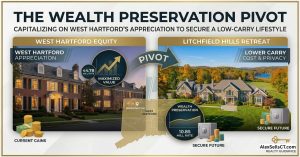
The Wealth Preservation Pivot: Capitalizing on West Hartford’s Appreciation for a Low-Carry Lifestyle
The Wealth Preservation Pivot Capitalizing on West Hartford’s Appreciation to Secure a Low-Carry Lifestyle If you own property in West Hartford, you are likely sitting on significant equity. Demand for luxury real estate across Connecticut-and specifically in our high-density hubs-is on a steady rise. For many homeowners, this creates a psychological “waiting game”: Is this […]
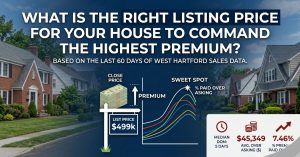
West Hartford Real Estate: The “Sweet Spot” Price to Command a 7.4% Premium
Market Insights What is the right listing price to command the highest premium? A data-driven analysis of West Hartford sales (Last 60 Days). Avg. Over Asking $45,349 Median DOM 5 Days Highest Premium 36.7% In today’s West Hartford market, your list price is more than a number-it’s a strategic lever. Based on 61 recent closed […]

The Secret Weapon for Home Sellers: Why You Should Be Crashing Open Houses
Seller Strategy Know Your Competition: Why Savvy Sellers Should Scout Local Open Houses Selling a home is a competitive business. While it might feel counterintuitive to visit other listings when you’re busy prepping your own, attending local open houses is one of the most effective ways to gain a strategic advantage. It’s not about finding […]
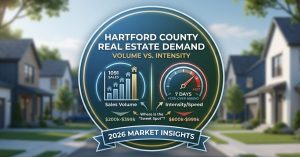
Decoding the Hartford County Real Estate “Sweet Spot”: Volume vs. Intensity
Linkedin Facebook X Market Analysis: Decoding Buyer Demand in Hartford County By Alex Teplitskiy | Real Estate Insights In real estate, we often talk about the “sweet spot” of the market. To a casual observer, that might look like the price range where the most homes are selling. But for a savvy buyer or seller, […]
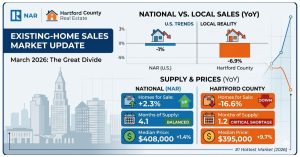
The #1 Hottest Market: Why Hartford Real Estate is Still a “Pressure Cooker”
Facebook X Linkedin The Great Divide: Why Hartford is Defying National Real Estate Trends If you’ve been watching the national news lately, you might think the housing market is finally cooling off. Headlines from the National Association of Realtors (NAR) show inventory is rising and sales are slowing. But if you are looking for a […]
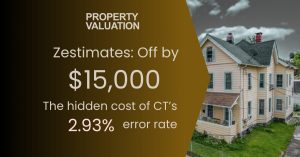
Is Zillow Accurate in Connecticut? The Truth About Active Listing Errors
Facebook X Linkedin Why “Zestimating” Your CT Home Could Cost You Thousands If you’re looking at homes in Connecticut, you’ve likely seen the Zestimate. It’s convenient and instant, but according to recent data, it is surprisingly off the mark for our unique local market. While Zillow’s algorithm performs well in states with high-density subdivisions like […]


© 2026 MoxiWorks
© CENTURY 21 2023 - 2024. All rights reserved. CENTURY 21®, C21® and the CENTURY 21 Logo are registered service marks owned by Century 21 Real Estate LLC. Franchisee Legal Entity Name (not the dba) fully supports the principles of the Fair Housing Act and the Equal Opportunity Act. Each franchise is independently owned and operated. Any services or products provided by independently owned and operated franchisees are not provided by, affiliated with, or related to Century 21 Real Estate LLC nor any of its affiliated companies.
